Jesus was observant. He certainly noticed everything from the cross. We, too, should be observant and meditate deeply upon everything surrounding the crucifixion of Our Lord.
This is a list of things Jesus saw from the cross on Good Friday, as seen through Scripture, with a few notes to assist your meditation.
1. Golgotha and the tomb
Jesus had seen Golgotha many times and knew its significance. Public executions were a billboard for Rome, a warning never to defy its power. Seeing his tomb from the cross would be like the nurse placing your coffin next to your bed in the hospice.
Luke 9:22: Jesus said, “The Son of Man must suffer many things . . . and be killed, and on the third day be raised.”
John 19:17: “[Jesus] went out, bearing his own cross, to the place called The Place of a Skull, which in Aramaic is called Golgotha.”
John 19:41: “In the place where he was crucified there was a garden, and in the garden a new tomb in which no one had yet been laid.”
2. His blood dripping down the wood of the cross
He is the perfect Passover Lamb whose blood was shed. In Egypt, the lamb’s blood was applied to vertical and horizontal beams of wood, so was the blood of Jesus dripping on the beams of the cross.
Exod. 12:7: “They shall take some of the blood of the Passover Lamb and put it on the two doorposts and the lintel of the houses.”
1 Cor. 5:7: “Christ, our Passover lamb, has been sacrificed.”
3. The crown of thorns piercing his head
John 19:2: “And the soldiers twisted together a crown of thorns and put it on his head and arrayed him in a purple robe.”
Gen. 22:13: “Abraham lifted up his eyes and looked, and behold, behind him was a ram, caught in a thicket by his horns. And Abraham went and took the ram and offered it up as a burnt offering instead of his son.”
St. Augustine: “When Abraham saw [the ram], he was caught by the horns in a thicket. What, then, did he represent but Jesus, who, before he was offered up, was crowned with thorns by the Jews?”
4. Mother Mary and St. John
Mary realized now what the prophet Simeon meant: “A sword will pierce through your own soul also” (Luke 2:35). Jesus gave Mary into the hands of his disciple John, which indicates that Mary had no other children, or Jesus would not have given him to Mary as a son. Thus, she becomes the mother of all disciples.
John 19:25-27: “When Jesus saw his mother, and the disciple whom he loved standing near, he said to his mother, ‘Woman, behold, your son!’ Then he said to the disciple, ‘Behold, your mother!’ And from that hour the disciple took her to his own home.”
5. The holy women
Matthew 27:55-56: “There were also many women there, looking on from afar, who had followed Jesus from Galilee, ministering to him; among whom were Mary Magdalene, and Mary the mother of James and Joseph, and the mother of the sons of Zebedee” (see John 19:25).
6. Taunting Jews
Luke 23:35: “The people stood by, watching; but the rulers scoffed at him, saying, ‘He saved others; let him save himself, if he is the Christ of God, his Chosen One!’”
Matthew 27:46-49: “About the ninth hour Jesus cried with a loud voice, ‘Eli, Eli, lama sabach-thani?” that is, ‘My God, my God, why hast thou forsaken me?’ And some of the bystanders hearing it said, ‘This man is calling Elijah.’ . . . But the others said, ‘Wait, let us see whether Elijah will come to save him.’”
7. Believing Jews and acquaintances
Luke 23:48-49: “All the multitudes who assembled to see the sight, when they saw what had taken place, returned home beating their breasts. And all his acquaintances and the women who had followed him from Galilee stood at a distance and saw these things.
8. Simon of Cyrene
Through his contact with Jesus and his cross, Simon became a believer, along with his sons Rufus and Alexander. Mark’s Gospel was written several decades after the Crucifixion, by which time the sons were well known to the Church.
Mark 15:21: “They compelled a passer-by, Simon of Cyrene, who was coming in from the country, the father of Alexander and Rufus, to carry his cross.”
Rom. 16:13: “Greet Rufus, eminent in the Lord.”
9. Centurion and soldiers
Luke 23:36-37: “The soldiers also mocked him, coming up and offering him vinegar, and saying, ‘If you are the King of the Jews, save yourself!’”
Matt. 27:54: “When the centurion and those who were with him, keeping watch over Jesus, saw the earthquake and what took place, they were filled with awe, and said, ‘Truly this was the Son of God!’”
10. Sponge with sour wine on a hyssop branch
John 19:29: “They put a sponge full of the sour wine on a hyssop branch and held it to his mouth.”
Exod. 12:21-22: “Kill the Passover lamb. Take a bunch of hyssop and dip it in the blood that is in the basin, and touch the lintel and the two doorposts with the blood.”
Hyssop is biblically related to cleansing. The sour wine may be the fourth cup, finishing the Passover meal. “It is finished” signals the completion of his work of reconciliation on the cross.
11. St. Longinus and his lance
John 19:34: “One of the soldiers pierced his side with a spear, and at once there came out blood and water.”
Longinus is the traditional name of the soldier who pierced the side of Christ. St. Bede and many others report that Longinus was martyred for his faith in Cappadocia in A.D. 58 and give March 15 as his feast day.
12. Nicodemus and Joseph of Arimathea
John 19:38-40: “Joseph of Arimathea, who was a disciple of Jesus, but secretly for fear of the Jews, asked Pilate that he might take away the body of Jesus, and Pilate gave him permission. So he came and took away his body. Nicodemus also, who earlier had come to Jesus by night, came bringing a mixture of myrrh and aloes, about seventy-five pounds in weight. So they took the body of Jesus and bound it in linen cloths with the spices, as is the burial custom of the Jews.”
13. Two thieves
Luke 23:39-43: “One of the criminals who were hanged railed at him, saying, ‘Are you not the Christ? Save yourself and us!’ But the other rebuked him, saying, ‘Do you not fear God, since you are under the same sentence of condemnation? And we indeed justly; for we are receiving the due reward of our deeds; but this man has done nothing wrong.’
“And he said, ‘Jesus, remember me when you come into your kingdom.’ And he said to him, ‘Truly, I say to you, today you will be with me in Paradise.’”
Though no names are mentioned in the Gospels, later tradition called the good thief St. Dismas and the bad thief Gestas.
14. Adam’s skull
Pious tradition holds that the skull of the first Adam was beneath the cross on Golgotha, which means “Place of the Skull.” Therefore, the blood of the New Adam dripped upon the skull of the first Adam for his redemption.
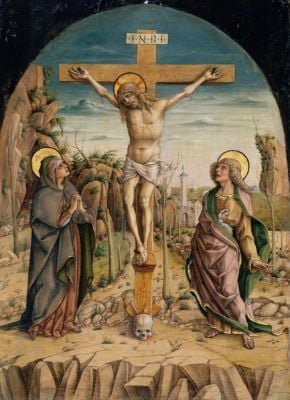
This was asserted by early Doctors and bishops of the Church. St. Athanasius (296-373) says that Christ did not suffer “in any other place, but in the Place of a Skull, which the Hebrew teachers declare was Adam’s sepulchre.”
15. The Father and the Holy Spirit
In everything, the Trinity operates together. Just like how Abraham was involved in the offering of his only begotten son, Isaac, so God the Father was present at the sacrifice of his only begotten Son. The Holy Spirit was also active in the sacrifice of Christ.
Heb. 9:14: “How much more will the blood of Christ, who through the eternal Spirit offered himself without blemish to God, purify our conscience from dead works to serve the living God.”
16. Satan and the evil spirits
1 Cor. 2:8: “None of the rulers of this age [Satan and his minions] understood this, for if they had, they would not have crucified the Lord of glory.”
“St. Ignatius of Antioch (martyred 107) said the Lord’s death escaped the notice of the prince of this world” (CCC 498).
“Had the wicked spirits known the mystery of Christ, they would never have incited men to crucify him. His death and resurrection are the world’s redemption and the destruction of their power and empire.”
1 John 3:8: “The reason the Son of God appeared was to destroy the works of the devil.”
17. Nature
Creation reacted against the crucifixion of its Creator. Augustine wrote, “Did not the creature acknowledge its Creator? . . . The earth bore witness: at his crucifixion, it quaked.”
St. John Chrysostom: “Whether they thought he himself had [caused the sun to darken at the crucifixion], they ought to have believed and to have feared . . . for that darkness was a token of his anger at their crime.”
Matt. 27:51: “The earth shook, and the rocks were split.”
Luke 23:44: “It was now about the sixth hour, and there was darkness over the whole land until the ninth hour.”
18. Corpses risen from their graves
Matt 27:52-53: “The tombs also were opened [at the crucifixion]. And many bodies of the saints who had fallen asleep were raised, and coming out of the tombs after his resurrection, they went into the holy city and appeared to many.”
19. The Temple
The Temple was massive, fifteen to eighteen stories high, set atop the lofty Temple Mount. Jesus loved his Father’s house (Luke 2:49). He could likely see it from the cross.
Jesus knew that his work on the cross would tear down the dividing wall and open access to God for the Gentiles. The Holy of Holies would now be open to everyone (Heb. 10:19-22).
Mark 15:37-38: “Jesus uttered a loud cry and breathed his last. And the curtain of the temple was torn in two, from top to bottom.”
Eph. 2:13-16: “But now in Christ Jesus you who once were far off have been brought near by the blood of Christ . . . [so he] might reconcile us both to God in one body through the cross.”
20. You and me
Rembrandt’s “Raising of the Cross” includes a self-portrait—notice the Dutch painter’s beret. He acknowledged that it was his sin that raised him on the cross—we were all there! Notice the centurion handing you the sword, handle first. He is telling you to take the sword and pierce his side yourself.
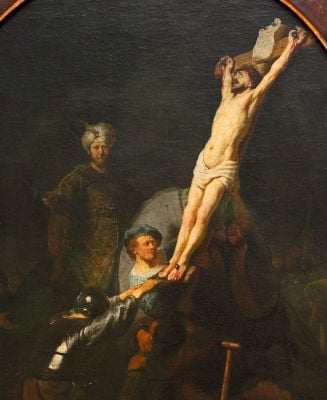
St. Francis of Assisi wrote, “Even the demons did not crucify him, but you, together with them, have crucified him and are still crucifying him by delighting in vices and sins.”